AI transcription technology has made significant advances in recent years, but accuracy remains a critical concern for businesses and content creators. Current AI transcription systems achieve accuracy rates ranging from 61% to 99% depending on audio quality, background noise, and speaker clarity. Understanding these accuracy levels helps users make informed decisions about when to use AI versus human transcription services.
The difference between AI and human transcription accuracy can be substantial. While human transcribers consistently achieve 99% accuracy rates, AI systems often fall short of this benchmark. However, AI transcription offers speed and cost advantages that make it attractive for many use cases, especially when users understand how to optimize their setup for better results.
Measuring transcription accuracy involves calculating Word Error Rate (WER), which counts substitutions, deletions, and insertions of words. Factors like speaker accent, background noise, technical vocabulary, and audio quality all impact how well AI systems perform. Modern AI transcription tools continue to improve through better algorithms and training data.
Key Takeaways
- AI transcription accuracy varies widely from 61% to 99% based on audio conditions and system quality
- Human transcribers maintain consistent 99% accuracy while AI offers faster and cheaper alternatives
- Audio quality, speaker clarity, and background noise are the main factors affecting transcription accuracy
Understanding AI Transcription Accuracy
AI transcription accuracy measures how correctly speech recognition systems convert spoken words into written text. The most common metrics include Word Error Rate and Character Error Rate, which determine how well these systems perform in practical situations.
Definition of AI Transcription Accuracy
AI transcription accuracy refers to how precisely artificial intelligence systems convert spoken language into written text. This measurement compares the AI-generated transcript against a perfect, human-verified version of the same audio.
Speech recognition systems analyze audio signals and predict the most likely words being spoken. The accuracy depends on how many words the AI system gets right compared to the total number of words in the original speech.
Current AI transcription platforms show varying levels of performance. Some studies indicate that AI systems achieve around 61.92% accuracy on average. However, top-performing systems can reach up to 86% accuracy under ideal conditions.
The accuracy rate changes based on several factors. Audio quality, background noise, speaker accents, and technical vocabulary all affect how well the AI performs. Clear audio with single speakers typically produces better results than complex conversations.
Key Metrics: Word Error Rate (WER) and Character Error Rate (CER)
Word Error Rate (WER) measures transcription accuracy by counting word-level mistakes. It calculates the percentage of words that are substituted, deleted, or inserted incorrectly during the speech-to-text process.
WER uses this formula: WER = (S + D + I) / N × 100
- S = Substitutions (wrong words)
- D = Deletions (missing words)
- I = Insertions (extra words)
- N = Total words in reference text
A WER of 10% means the system makes errors in 1 out of every 10 words. Lower WER scores indicate better performance.
Character Error Rate (CER) works similarly but focuses on individual characters instead of whole words. This metric proves useful for languages where word boundaries are less clear or when analyzing partial word accuracy.
CER helps identify specific types of errors that WER might miss. For example, if the AI writes “there” instead of “their,” WER counts this as one error, but CER shows the specific character-level mistakes.
Both metrics provide different insights into system performance. WER gives a broader view of transcript quality, while CER offers detailed error analysis.
Importance of Transcription Accuracy in Real-World Applications
Transcription accuracy directly impacts business operations and decision-making processes. When AI systems produce incorrect transcripts, the errors flow through to all downstream applications that rely on that text data.
Business Intelligence suffers when transcription errors distort meaning. Coaching insights become unreliable, and sentiment analysis produces wrong conclusions. Companies may make poor decisions based on flawed data from inaccurate transcripts.
Compliance and Legal Requirements demand high accuracy levels. Medical transcriptions, legal depositions, and financial recordings require precise documentation. Small errors can lead to serious legal or safety consequences.
Automation Systems malfunction when they receive incorrect input from speech-to-text systems. Customer service bots may provide wrong responses, and voice-activated systems may execute unintended commands.
Content Creation relies heavily on accurate transcription for podcasts, interviews, and video content. Errors create extra work for editors and can change the intended message completely.
The cost of fixing transcription errors often exceeds the initial investment in higher-quality systems. Organizations must balance speed and cost against the accuracy requirements of their specific use cases.
Human transcriptionists still achieve 99% accuracy rates compared to AI systems. This gap explains why many critical applications continue to rely on human expertise despite AI advances.
Measurement Methods for Transcription Accuracy
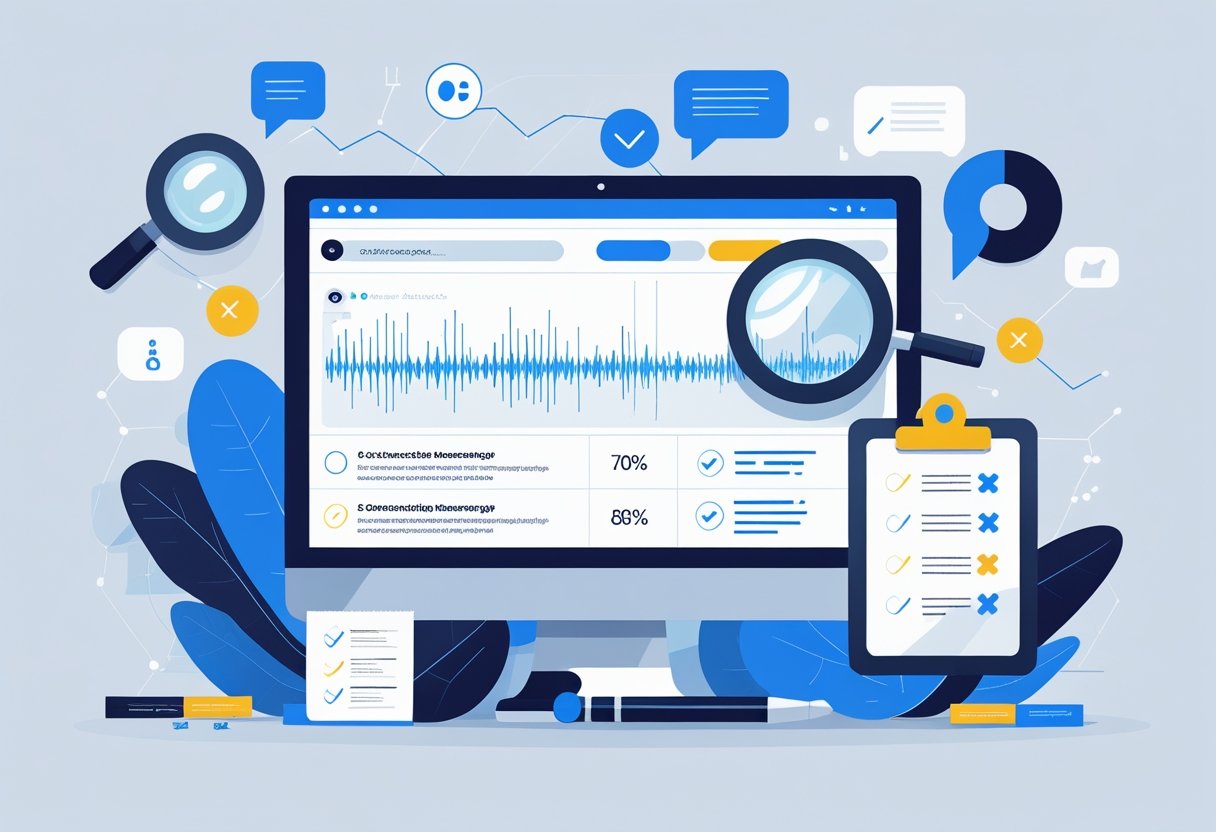
AI transcription accuracy relies on specific mathematical formulas that compare the generated text against reference transcripts. These methods examine word-level errors, character-level mistakes, and the overall meaning preservation in the final output.
How Word Error Rate (WER) Is Calculated
WER serves as the primary benchmark for measuring AI transcription tools performance. The calculation uses a simple formula that divides the total number of errors by the total words in the reference transcript.
The formula counts three types of mistakes: substitutions, insertions, and deletions. A substitution occurs when the AI writes “cat” instead of “car.” An insertion happens when extra words appear in the transcript. A deletion means the system misses words entirely.
WER Formula:
- WER = (S + I + D) / N × 100
- S = Substitutions
- I = Insertions
- D = Deletions
- N = Total words in reference
Most professional transcription services aim for WER scores below 5%. Research-grade systems often achieve rates between 1-3%. The lower the WER percentage, the more accurate the transcription system performs.
Role of Character Error Rate (CER) in Evaluation
Character error rate provides a more detailed view of transcription mistakes than WER alone. This metric examines individual letters, numbers, and punctuation marks rather than complete words.
CER becomes especially useful when evaluating languages with complex word structures. It also helps identify specific problems with proper nouns, technical terms, or unusual spellings that WER might miss.
The calculation follows the same principle as WER but counts character-level errors:
- CER = (Character substitutions + insertions + deletions) / Total characters × 100
CER typically shows lower error percentages than WER because most characters remain correct even when words contain mistakes. A 10% WER might correspond to a 3-4% CER in typical transcripts.
Evaluating Semantic and Contextual Accuracy
Traditional accuracy benchmarks focus on exact word matches but miss meaning preservation. Semantic evaluation examines whether the transcript conveys the original message correctly, even with minor word differences.
Contextual accuracy measures how well AI systems handle complex speech patterns. This includes speaker identification, emotional tone, and conversational flow. These factors matter significantly in business meetings, legal proceedings, and medical consultations.
Modern evaluation methods use natural language processing to compare meaning similarity. They analyze sentence structure, key concepts, and logical relationships between ideas. Some advanced systems assign separate scores for factual accuracy versus linguistic precision.
Key semantic evaluation areas:
- Main topic identification
- Speaker intent preservation
- Technical term accuracy
- Temporal sequence maintenance
Human reviewers often provide the final assessment of semantic accuracy since automated tools cannot fully capture meaning nuances.
Factors Affecting AI Transcription Accuracy
AI transcription software relies on machine learning algorithms that perform differently based on recording conditions, speaker characteristics, and specialized terminology. Audio clarity, background interference, accent variations, and domain-specific language create the biggest challenges for accurate speech-to-text conversion.
Audio Quality and Background Noise
Clear audio recordings produce the best results for AI transcription software. High-quality microphones and proper recording equipment capture speech at optimal levels for machine learning algorithms to process effectively.
Background noise creates significant problems for transcription accuracy. Common interference includes:
- Air conditioning systems – Creates constant low-frequency hum
- Traffic sounds – Varies in intensity and frequency
- Multiple speakers – Overlapping voices confuse the software
- Echo and reverb – Distorts speech patterns in large rooms
Poor audio quality forces AI systems to guess at unclear words. This leads to mistakes that compound throughout the transcript.
Recording at 16 kHz or higher sample rates helps maintain audio clarity. Files with bit rates below 64 kbps often produce transcription errors due to compression artifacts.
Speaker Accents and Dialects
AI transcription accuracy drops when processing non-standard accents and regional dialects. Most systems train primarily on neutral American English, creating gaps in recognition for other speech patterns.
Regional accents affect pronunciation of vowels and consonants. Southern American, British, Australian, and international English speakers often experience lower accuracy rates than speakers with General American accents.
Heavy accents can reduce transcription accuracy by 15-25% compared to clear, neutral speech. Non-native English speakers face additional challenges as AI systems struggle with:
- Irregular stress patterns
- Mispronounced consonant clusters
- Non-standard grammar structures
- Code-switching between languages
Some AI transcription services offer accent-specific models. These specialized algorithms improve results for particular regional dialects or international English variations.
Custom Vocabulary and Domain Terminology
Technical terms, brand names, and specialized vocabulary create accuracy problems for general AI transcription systems. Medical terminology, legal jargon, and industry-specific language often get transcribed incorrectly.
Standard AI models lack training on niche vocabularies. A cardiology discussion might incorrectly transcribe “myocardial infarction” as “my cardiac infection” without proper medical training data.
Custom vocabulary features help address this issue:
| Domain | Common Issues | Solutions |
|---|---|---|
| Medical | Drug names, procedures | Medical-trained models |
| Legal | Case citations, Latin terms | Legal vocabulary lists |
| Technology | Product names, acronyms | Custom dictionaries |
Many AI transcription platforms allow users to upload custom word lists. These additions help the software recognize specific terms that appear frequently in particular industries or organizations.
Real-World Recording Conditions
Laboratory testing conditions differ greatly from actual recording environments. Real-world factors significantly impact AI transcription performance beyond controlled testing scenarios.
Phone calls introduce compression and bandwidth limitations that degrade audio quality. Video conferences add network latency and compression artifacts that challenge transcription algorithms.
Meeting recordings present multiple challenges:
- Participants sitting at different distances from microphones
- Side conversations and interruptions
- Presentation audio mixing with speaker voices
- Poor acoustics in conference rooms
Mobile device recordings often suffer from handling noise, wind interference, and automatic gain control that creates volume fluctuations. These variables reduce transcription accuracy compared to studio-quality recordings.
Environmental factors like room size, wall materials, and furniture placement affect audio clarity. Hard surfaces create echoes while soft furnishings absorb sound, both impacting transcription quality.
Comparison: Traditional vs. AI-Powered Transcription
Human transcriptionists achieve 99% accuracy for specialized content while AI-powered transcription reaches 92% accuracy in 2025. Processing speed differs dramatically, with AI solutions working five times faster than traditional methods.
Manual Transcription Accuracy Benchmarks
Traditional transcription relies on trained professionals who listen to audio recordings and type what they hear. Human transcriptionists consistently deliver accuracy rates between 95% and 99% for most content types.
Manual transcription excels with complex terminology and specialized fields. Medical transcriptionists handle nuanced differences like “hypo” versus “hyper” with precision. They also manage multiple speakers, accents, and background noise effectively.
Key strengths of manual transcription:
- Superior context understanding
- Accurate punctuation and grammar
- Better handling of unclear audio
- Recognition of speaker emotions and tone
Human transcriptionists take time to research unfamiliar terms. They can distinguish between similar-sounding words based on context. This careful approach leads to fewer errors in the final transcript.
WER (Word Error Rate) for professional human transcriptionists typically ranges from 1% to 5%. This makes manual transcription the gold standard for critical documents.
AI-Powered Transcription Performance
AI transcription systems use machine learning and neural networks to convert speech to text. Modern AI tools achieve 92% accuracy rates in 2025, showing significant improvement from earlier versions.
AI-powered transcription struggles with specialized vocabulary and technical terms. Medical and legal terminology often creates challenges for automated systems. Background noise and poor audio quality reduce AI accuracy further.
Current AI transcription limitations:
- Difficulty with accents and dialects
- Confusion with homophones
- Poor performance with multiple speakers
- Limited context understanding
AI systems work best with clear audio and standard vocabulary. Single-speaker recordings in quiet environments produce the highest accuracy rates. Some AI tools now offer real-time transcription across multiple languages.
Cloud-based AI solutions continue improving through machine learning. Each processed audio file helps train the system for better future performance.
Speed and Cost Considerations
AI transcription processes audio files in minutes rather than hours. Cloud-based solutions deliver results five times faster than traditional methods. Real-time transcription happens instantly during live events or meetings.
Manual transcription typically takes three to four hours per hour of audio. Professional transcriptionists charge $1 to $3 per minute of audio content.
AI-powered services cost significantly less than human transcriptionists. Most AI platforms charge $0.10 to $0.25 per minute of audio. This makes AI transcription attractive for large-volume projects.
Cost comparison per hour of audio:
- Manual transcription: $60-$180
- AI transcription: $6-$15
Traditional transcription offers better accuracy but requires more time and money. AI transcription provides quick results at lower costs but sacrifices some precision.
Leading AI Transcription Tools and Software
Several AI transcription platforms have emerged as market leaders, each offering unique strengths in accuracy, speed, and specialized features. The top tools vary significantly in their approach to speech recognition, with some focusing on real-time processing while others prioritize post-production accuracy through human verification.
Overview of Top AI Transcription Tools
Otter.ai stands out for its exceptional accuracy and comprehensive feature set. The platform excels at real-time transcription during meetings and interviews. It offers speaker identification and integrates seamlessly with video conferencing tools.
Rev combines AI technology with human editors to deliver highly accurate results. This hybrid approach makes it particularly valuable for professional applications where precision matters most.
GoTranscript represents the gold standard for accuracy by pairing artificial intelligence with human transcriptionists. This combination produces the most reliable transcripts available in the current market.
Other notable platforms include Whisper, Riverside, and Trint. Each tool targets specific use cases, from academic research to media production.
The best ai transcription software typically supports multiple languages and accents. Most platforms now offer cloud-based processing for faster turnaround times.
Feature Comparison of Popular Platforms
| Platform | Real-time | Speaker ID | Human Review | Languages | Best For |
|---|---|---|---|---|---|
| Otter.ai | Yes | Yes | No | 3+ | Meetings |
| Rev | No | Yes | Yes | 36+ | Professional |
| GoTranscript | No | Yes | Yes | 60+ | High accuracy |
Real-time transcription works best for live events and meetings. Otter.ai leads in this category with instant speech to text conversion.
Speaker identification helps distinguish between different voices in recordings. Most leading platforms now include this feature as standard.
Human review significantly improves accuracy but increases processing time. Rev and GoTranscript offer this premium service for critical documents.
The transcript editor functionality varies widely between platforms. Some provide basic text editing while others offer advanced formatting tools.
Accuracy and User Experience: Case Studies
Legal professionals report 95% accuracy rates when using GoTranscript for court proceedings. The human verification step catches technical terminology that AI alone might miss.
Medical practices achieve 92% accuracy with Otter.ai for patient consultations. The platform’s ability to learn medical vocabulary improves performance over time.
Media companies using Rev for interview transcription report 94% accuracy rates. The combination of AI speed and human precision meets tight deadlines while maintaining quality.
Academic researchers find Whisper particularly effective for recorded lectures. The open-source platform handles various accents and speaking speeds well.
User experience varies significantly across platforms. Otter.ai receives praise for its intuitive interface and seamless mobile app integration.
Rev users appreciate the consistent quality but note longer turnaround times. The trade-off between speed and accuracy becomes a key decision factor for many organizations.
Best Practices for Improving AI Transcription Accuracy
High-quality audio recordings form the foundation of accurate AI transcription, while proper editing tools and software selection can significantly boost final results. These three core areas work together to minimize errors and maximize transcription quality.
Optimizing Audio Quality for Higher Accuracy
Audio quality directly impacts how well AI transcription software can recognize and convert speech to text. Poor audio creates more errors that require extensive editing later.
Recording Environment
Choose quiet spaces with minimal background noise. Hard surfaces like concrete walls create echo that confuses AI systems. Carpeted rooms or spaces with soft furnishings work better.
Microphone Positioning
Keep microphones 6-12 inches from speakers’ mouths. Closer placement captures more detail but may cause breathing sounds. Test different distances to find the sweet spot.
Audio Format Requirements
Use these settings for best results:
- Sample rate: 16 kHz or higher
- Bit depth: 16-bit minimum
- File format: WAV or FLAC preferred over MP3
Speaking Guidelines
Speakers should talk at normal pace and volume. Rapid speech reduces accuracy significantly. Clear pronunciation matters more than perfect grammar.
Utilizing Transcript Editors Effectively
A good transcript editor helps fix errors quickly and improves the final output quality. Most AI transcription tools include built-in editing features.
Common Error Types
Look for these frequent mistakes:
- Homophone confusion (there/their/they’re)
- Names and technical terms
- Numbers and dates
- Punctuation placement
Editing Workflow
Start by reading through the entire transcript first. Mark unclear sections during this initial review. Then go back and fix specific errors.
Speaker Identification
Many editors allow manual speaker labeling. This helps when AI transcription struggles to tell voices apart. Add speaker tags early in the editing process.
Formatting Tools
Use bold text for emphasis and italics for unclear speech. Add timestamps for important sections. Most transcript editors support these formatting options.
Selecting the Right Tool for Your Needs
Different transcription software works better for specific use cases. Consider your audio types, accuracy needs, and budget when choosing.
Accuracy Levels
Premium tools typically achieve 85-95% accuracy with good audio. Free options often provide 70-85% accuracy. Factor in editing time when comparing costs.
Language Support
Check if the software handles your required languages well. Some tools excel with English but struggle with other languages or accents.
Integration Features
Consider tools that connect with your existing workflow. Many offer APIs or direct exports to common document formats.
Specialized Features
| Feature | Best For |
|---|---|
| Speaker diarization | Multi-person recordings |
| Custom vocabulary | Technical or industry content |
| Real-time transcription | Live events or meetings |
| Batch processing | Large file volumes |
Frequently Asked Questions
AI transcription accuracy depends on multiple factors like audio quality and speaker characteristics. Most current systems achieve 95-98% accuracy rates, with some services claiming higher precision under ideal conditions.
How can the accuracy of AI transcription services be measured?
AI transcription accuracy gets measured by comparing the transcribed text to a perfect reference transcript. This creates a percentage score based on correct words versus total words.
The most common method is Word Error Rate (WER). It calculates the number of substitutions, deletions, and insertions needed to match the original text.
Most professional services aim for 95% accuracy or higher. Some specialized tools claim to reach 98-99% accuracy under optimal conditions.
What factors influence the accuracy of AI transcription?
Audio quality plays the biggest role in transcription accuracy. Clear recordings with minimal background noise produce the best results.
Speaker characteristics also matter significantly. Factors include speaking speed, pronunciation clarity, and volume levels.
Background noise reduces accuracy rates. Multiple speakers talking at once creates additional challenges for AI systems.
The AI system’s training data affects performance. Systems trained on diverse datasets handle different speech patterns better.
Which AI transcription service is recognized as the most precise?
No single AI transcription service consistently outperforms all others across every scenario. Different services excel in specific areas or use cases.
Some services perform better with technical vocabulary. Others handle conversational speech more effectively.
The most accurate service depends on your specific needs. Factors include audio type, speaker accents, and subject matter.
Testing multiple services with your actual audio files provides the best accuracy comparison.
Is it feasible for AI transcription to achieve perfection in accuracy?
Perfect AI transcription accuracy remains unlikely due to the complexity of human speech. Variables like accents, background noise, and unclear pronunciation create ongoing challenges.
Current AI systems reach 95-98% accuracy in ideal conditions. This represents significant improvement from earlier versions.
Human transcribers also make errors, typically achieving 95-99% accuracy. The gap between AI and human performance continues to narrow.
Technical limitations in speech recognition technology make 100% accuracy extremely difficult to achieve consistently.
What advancements are being made to improve AI transcription accuracy?
Machine learning models continue improving through better training datasets. These include more diverse speech samples and languages.
Context awareness helps AI systems understand speech better. Advanced models consider surrounding words and phrases for more accurate predictions.
Real-time processing capabilities have improved significantly. Some systems now transcribe speech as fast as people speak.
Integration with other AI technologies enhances accuracy. Natural language processing helps correct common transcription errors automatically.
How does AI transcription perform with different accents and dialects?
AI transcription accuracy varies significantly across different accents and dialects. Systems trained primarily on standard American or British English often struggle with other variations.
Regional accents can reduce accuracy by 10-20% compared to neutral speech patterns. Strong accents or dialects may see even larger accuracy drops.
Some AI services offer accent-specific training models. These specialized systems perform better with particular regional speech patterns.
Non-native speakers often experience lower transcription accuracy. Pronunciation differences and speech rhythm variations create additional challenges for AI systems.
Related Articles

Automatic Meeting Notes: How AI-Powered Tools Transform Workplace Productivity

Voice Notes to Text: How AI Transcription Tools Are Revolutionizing Digital Communication